

Thrifting in Westchester is renowned for its high-quality donated items. Many residents live in affluent neighborhoods, so local thrift stores often stock premium brands, vintage furniture, and luxury accessories at prices generally lower than those in Manhattan. Each store has a unique atmosphere, adding variety to the secondhand shopping experience.
In Westchester’s thrift scene, timing is crucial for success. Because most shops get their largest donations on weekends, the best times to find new inventory are early Monday and Tuesday mornings, before items are heavily picked over.
Practicality significantly influences the Westchester scene. Most prominent shops are run by local religious or nonprofit groups, and usually close earlier than typical thrift stores. Many are staffed by volunteers. Savvy shoppers keep an eye on community calendars, since many of these stores host seasonal “bag sales,” where customers pay a fixed fee to fill a bag.
Here’s a list of some of my favorite thrift stores in Westchester County I’ve visited over the past year. I genuinely appreciate the friendly staff, excellent deals, and how many staff members recognize my enthusiasm for thrifting and sharing it. I enjoy emphasizing how these shops support and uplift their local communities. If your favorite thrift store isn’t included here, feel free to email me at tonionthrifting@gmail.com, and I’ll try to visit soon.
Here are a few thrift shops I visited during the past year:
St Bart’s Thrift Shop
— 82 Prospect St, White Plains, NY
Follow on Facebook for news: https://www.facebook.com/stbartsthrift/
Located in White Plains, NY, this shop offers affordable pre-owned clothing and household items. It features a large, ever-changing selection of women’s clothing, operated from a space behind St. Bart’s Church. The constantly rotating inventory encourages frequent visits to discover unique finds. All proceeds are reinvested in the community. This thrift shop is also one of my personal favorites and one I visit very often.
The L.I.S.A Boutique
— 137 7thh Ave, Verplanck, NY 10591
https://letitshineonline.com/home-%2F-pantry-%2F-thrift
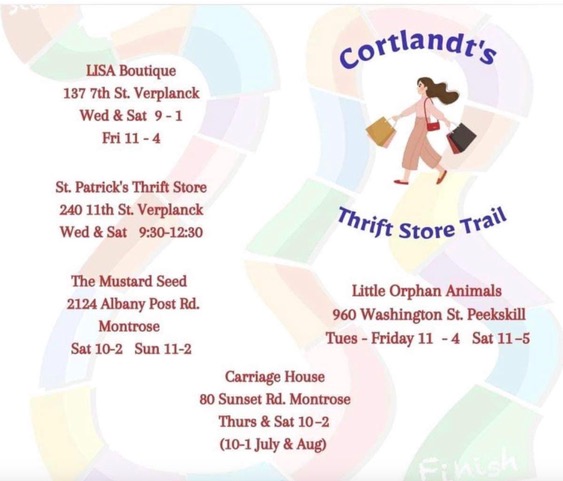
Located in Verplanck and well worth a visit. It is not a large boutique, but it is packed with excellent women’s clothes, gorgeous jewelry and accessories, and beautiful household goods. and it is also part of Cortlandt’s Thrift Store Trail which includes St. Patrick’s, Carriage House Thrift Shop, Little Orphan Animals, and the Mustard Seed, all worth the trip
The Back Door Thrift Shop
— 20 Greenridge Ave, White Plains, NY 10605
https://www.hiwp.org/thrift_shop
This charming, welcoming shop in White Plains, NY, lives up to its name with its entrance at the back of a parking lot behind the Hebrew Institute Synagogue. It features high-quality pre-owned items, such as vintage dresses, coats, and home decor, with all proceeds benefiting synagogue programs and activities.
Fantastic Finds
—400 King St, Chappaqua, NY
Located in Chappaqua’s Talbot’s Shopping Center, Fantastic Finds is an upscale resale boutique that operates as a non-profit. All proceeds from the shop directly benefit Support Connection, a non-profit organization that provides free, year-round support services for individuals affected by breast, ovarian, and gynecological cancers.
Hitchcock Church Thrift Shop
— 6 Greenacres Ave, Scarsdale, NY 10583
https://www.hitchcockpresby.org/thrift-shop
Located in Scarsdale, NY, this shop is run by Presbyterian Women and raises thousands of dollars each year for various women’s and children’s charities. It sells clothing, household items, and jewelry, and offers a chance for community volunteering and friendship.
Habitat for Humanity ReStore
— 470 Nepperhan Ave, Yonkers, NY 10701
Tel: (332) 777-5060
This large nonprofit home improvement store and donation center is located in Yonkers, NY. It offers new and gently used furniture, appliances, building materials, and home accessories at affordable prices. All proceeds support Habitat for Humanity NYC and Westchester County’s mission to build homes.
Red Door Thrift Store
— 100 Underhill St, Yonkers, NY 10710
http://www.stjohnstuckahoe.com/thrift-shop.html
Situated in Yonkers, NY, this thrift store sells gently used clothes, household items, books, collectibles, and more at affordable prices. All proceeds benefit the ministries of St. John’s Episcopal Church, Tuckahoe.
Treasure Thrift Shop
— 50 Bedford Rd, Armonk, NY
Located in Armonk, NY, this volunteer-run, eco-friendly shop offers affordable new and gently used items, with proceeds supporting various local charities. It operates on limited hours, usually Wednesdays and Saturdays, making it a great place to find unique vintage treasures. This is an all-around great thrift shop and one I always enjoy shopping in.
https://www.treasuresthriftshop.org/
Twigs Thriftree
— 449 Lexington Ave, Mount Kisco, NY 10549
This volunteer-operated store in Mount Kisco, NY, raises funds exclusively for Northern Westchester Hospital and has already collected millions of dollars. It features a wide variety of gently used clothing and costume jewelry.
Yorktown Love In Action
— 1736 Front St, Yorktown Heights, NY 10598
https://www.yorktownloveinaction.com/
A nonprofit recognized as a 501(c)(3) based in Yorktown Heights, NY, runs a large 10,000-square-foot thrift shop warehouse. Its goal is to assist families facing hardship in Westchester and Putnam counties. The organization provides donated items like furniture, clothing, and toys, known for its affordable prices and neatly organized, wide-ranging selection. Another popular spot where you could easily spend hours.
I hope you enjoyed it. Stay tuned for more. I am currently working on part 2 of “Explore Affordable Thrift Shopping in Westchester County.”
Check out my Facebook page for engaging articles and updates on local thrift shopping.
Until next time, Happy Thrifting!


 ToniOnThrifting