ToniOnThrifting

ToniOnThrifting – Thrift Shopping Made Simple

Thrift Shopping: A Sustainable Way to Find Unique Holiday Gifts And Creative Ways To Wrap Them — November 23, 2025

Thrift Shopping: A Sustainable Way to Find Unique Holiday Gifts And Creative Ways To Wrap Them

Thrift shopping for holiday gifts has clear environmental, economic, and personal benefits, making it a sustainable and thoughtful alternative to traditional retail. It helps reduce waste, saves money, and adds the excitement of discovering unique items.

Economic Advantages:

Thrift shopping is a smart way to save money and reduce holiday expenses. It offers big savings since secondhand items are usually much cheaper than new ones, often including high-quality or designer pieces at great discounts. This helps you stretch your holiday budget further without sacrificing quality. Also, many thrift stores are run by charities or local groups, so your purchases support important community programs like homelessness support and domestic violence shelters. Plus, used items typically come with little or no packaging, which helps cut waste and can lower costs for buyers.

Unique & Thoughtful Gifts:

Beyond the tangible benefits, thrifting allows for a more personal and intentional approach to gift-giving.

  • Thrift stores offer a continually updated, varied selection of items, including vintage accessories, rare books, and retro decor. This makes it easy to find a distinctive gift that perfectly suits the recipient’s personality.
  • Meaningful Intentionality: Spending time and effort on a “treasure hunt” to find the ideal item can increase its emotional significance. A carefully selected secondhand gift can convey a special story, making it more meaningful than a quick purchase from an online retailer or a big-box store shelf.

Opting to thrift for holiday gifts benefits the environment, saves money, and shows greater thoughtfulness.

Now, try creative and eco-friendly ways to wrap those gifts. Use repurposed materials such as maps or newspapers, experiment with the Japanese fabric wrapping method (Furoshiki), or incorporate natural elements for decoration.

Repurposed Paper:

Instead of buying new, glossy wrapping paper that often cannot be recycled, you can use materials you likely already have around the house.

  • Old Maps/Calendars: Out-of-date road maps, topographical charts, or large calendar pictures add a unique, vintage feel. You can even match the map location to the gift or recipient’s interests (e.g., a marine chart for a boat-related gift).
  • Newspaper or magazine pages—whether black-and-white print, colorful magazine spreads, or even the comic section—can serve as charming and eco-friendly wrapping options.
  • Brown Paper Bags: Flattened paper grocery bags or kraft paper from shipping boxes serve as a simple canvas. Personalize it with doodles, stamps, or stencils for a unique touch.
  • Children’s Artwork: Wrapping a gift in your children’s paintings or drawings adds a deeply personal and artistic touch that family members often cherish as a keepsake.

Fabric Wrapping (Furoshiki):

The traditional Japanese art of Furoshiki uses fabric to wrap or transport goods, offering an elegant, reusable, and zero-waste option.

  • Scarves or Tea Towels: The fabric itself can be part of the gift. Use a vintage scarf, a festive tea towel, or a cloth napkin to wrap the item.
  • Fabric Scraps: Repurpose old t-shirts, worn-out bedding, or fabric remnants found at a thrift store.
  • Technique: No tape or scissors are needed; the fabric is secured using strategic folding and knotting techniques. This creates a beautiful, soft presentation that can be reused year after year.

Natural Embellishments & Containers:

Elevate the look of your gifts with natural, compostable additions and unique, reusable “containers”.

  • Natural Accents: Avoid plastic ribbons and bows. Instead, opt for natural materials like jute, twine, or raffia to secure the package. Add a sprig of fresh rosemary, pinecones, dried citrus slices, or cinnamon sticks for a festive aroma and rustic charm.
  • Reusable Containers: For small or oddly shaped items, opt for a decorative tin from cookies or tea, a clean glass jar ideal for homemade treats, a small kit, or a durable thrifted basket. These containers can be part of the gift or serve as useful storage afterward.
  • Handmade Tags: Repurpose last year’s holiday cards by cutting them into new gift tags.

By utilizing these creative approaches, you can make your thrifted gifts look unique and intentional while significantly reducing holiday waste.

Environmental Sustainability:

Buying secondhand items helps reduce environmental damage caused by manufacturing new products, especially in sectors like fast fashion. Waste Reduction: Each thrifted item cuts down the need for new production. This lowers the millions of tons of textile and general waste that fill landfills each year. Resource Conservation: Making new products uses a lot of resources. For instance, producing a single cotton T-shirt requires over 700 gallons of water. This resource is saved when buying pre-owned items. Thrifting saves water, energy, and raw materials. Lower Carbon Footprint: The processes of creating and transporting new products are significant sources of global carbon emissions. Choosing secondhand can cut a product’s carbon footprint by up to 90%, since most energy-consuming steps are already done.

I hope you enjoyed this blog. Let’s continue to reduce, reuse, and recycle.

Until next time, Happy Thrifting!

How to Donate Clothes with Purpose — May 19, 2025

How to Donate Clothes with Purpose

We have all had those bags, boxes, or items in our house or the back of our car, which we keep forgetting to donate. Eventually, they arrive, but what happens to the donated clothing or textiles after you drop them off can be alarming. According to Earth.com, approximately 92 tons of global textile waste are generated yearly, which is expected to double by 2030. The most important thing we can do is donate mindfully so that most of our donations DO NOT end up in landfills and significantly harm the environment. Better recycling practices help us help the environment. Reduce, reuse, and recycle are the keys to my life. Here are some of my tips and ideas for mindfully donating your clothes and other items, with purpose and sustainability in mind.


Let us start with the donation itself. First, please ensure that the clothes are clean and in the condition you would want if you purchased the same item. They should be free of stains and tears. This is the best way to ensure your items are resold or donated to someone in need. Additionally, donating seasonal clothes at the beginning of a season is beneficial to ensure they are immediately usable. If an item is household, please ensure it is not broken, usable, and void of cracks and chips (also making it an unsafe donation).


The following is imperative and will significantly reduce waste. Check with the donation center or thrift shop to get a clear picture of what is and is not accepted. When you drop off something a shop does not take, it ends up in the garbage and eventually a landfill. That is precisely what we do not want to happen. Additionally, the staff at thrift shops cannot emphasize enough how detrimental it is when donations are dropped off when a shop is closed, especially in inclement weather, as the donations become unusable and end up as garbage. Visit during the shop’s operating hours. Remember, volunteers run those small, independent thrift shops, and why waste precious volunteer time sorting and discarding what could have been usable donations? Of course, there is always Goodwill and the Salvation Army.


I have donated board games along with books to my local library. For books, there are Little Free Libraries across the country where you can both give and take a book. One just opened this week near me, and it’s such a great idea for our local community. Here is the link https://littlefreelibrary.org/. There is the Buy Nothing Project on Facebook, which so many local communities are involved in for many items. I have found this to be an excellent resource for giving away items I no longer use and receiving items I would not have to buy, as someone may be giving them away. I have given away everything, from food and clothing to décor and toiletries, and received the same in return. It is an excellent way to connect with a community of like-minded individuals who want to repurpose items they are no longer using or need.


I donate gently used business clothing to the Bottomless Closet in New York City, where they help disadvantaged women acquire the tools and resources they need to re-enter the workforce and achieve their career goals. Organizations like the Bottomless Closet, Dress for Success, and many others help individuals re-enter the workforce and may need business clothing, handbags, shoes, and accessories. You can also check your local house of worship to see if they are hosting a tag sale or rummage sale, or if they have families in need. Check your local homeless shelter to see what donations are most needed. They may also take household items for people transitioning into permanent housing. That would be great for the kitchen, bedding, and many other items you would like to have a second life with.

Some retailers, such as Eileen Fish, offer buy-back services for their products. Madewell Forever takes all types of clothing by mail, and DSW takes all kinds of shoes—check their website for details. Trashie’s Take Back Bag recycling program is user-friendly. You can purchase bags, fill them, and earn points in rewards for gift cards. Their goal is to redistribute or recycle your items in a responsible and environmentally friendly manner. The website provides valuable information about their activities.

I am trying to buy fewer items and only purchase quality products so that they last longer. Additionally, I strive to stay as far away from fast fashion as possible. Additionally, I try to repair and repurpose. Do you have items that require minor repairs to make them wearable again, especially for high-quality items? An inexpensive sewing kit and numerous YouTube videos (for the tricky repairs) can help you with this. Perhaps it just needs a good ironing or steaming — that could be all it needs to breathe new life into a piece of clothing. Do not throw out old sheets and blankets – check with your local animal shelter to see what they could use, and donate those items to help animals in need.


How we donate can positively impact the environment, especially in our local communities. If we donate mindfully, we play a crucial role in extending the lifespan of items no longer needed, and we can help save this beautiful planet for future generations.

I hope that you find this information helpful.

Until next time, Happy Thrifting!

In the spirit of giving back, I would like to highlight Clothes To Kids Fairfield County and how you can help! — December 5, 2024

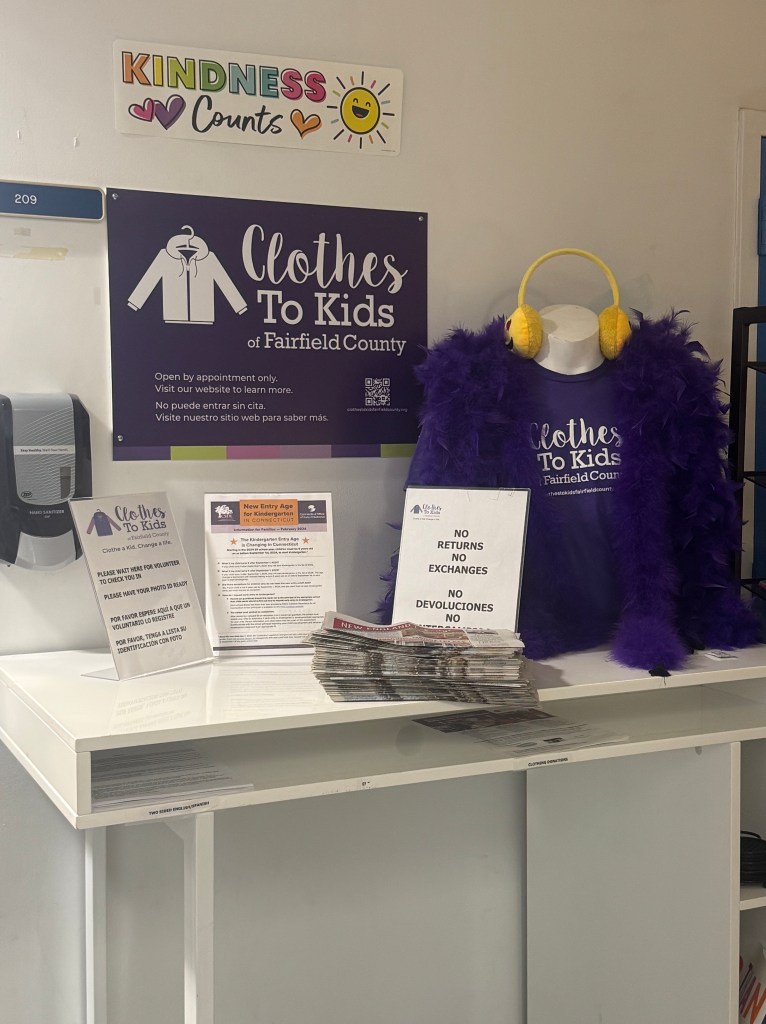
In the spirit of giving back, I would like to highlight Clothes To Kids Fairfield County and how you can help!

In the spirit of the holiday season, my next couple of blogs will focus on how we can help others in need. This blog highlights Clothes To Kids Fairfield County and how they are helping kids in need.

Clothes To Kids of Fairfield County (CTKF) envisions a community in which every school-age child has quality clothing so they may attend school with the confidence and self-esteem needed to achieve academic success. Their unique approach is a boutique-style setting where children work with a personal shopper to choose the clothing they like. The shopping experience is geared toward giving kids the dignity and respect they deserve. Elaine Rubinson got the idea to bring CTKF to Stamford, CT, after she attended a Clothes to Kids fundraiser in 2014 in St. Petersburg, Florida. Florida currently has three boutique Clothes to Kids locations: one in St. Petersburg, one in Tampa, and the original location in Clearwater. Two other Clothes to Kids boutiques are in Denver, Colorado, Providence, Rhode Island, and a third smaller outlet in Waynesville, North Carolina.

CTKF is a remarkable charity, but it can only be viable and even more successful with your help. Clothing insecurity is a hidden crisis in the United States, affecting an estimated two out of every five children. For some children, this means enduring cold weather without a winter coat. For others, it means having to wear clothes that are too small or not being able to participate in gym class because they don’t have proper sneakers. Last year alone, CTKF supplied more than 1,000 outfits to eligible kids and kids in crisis in 2024 and anticipates a greater number of distributions in 2025. The number increases every year.

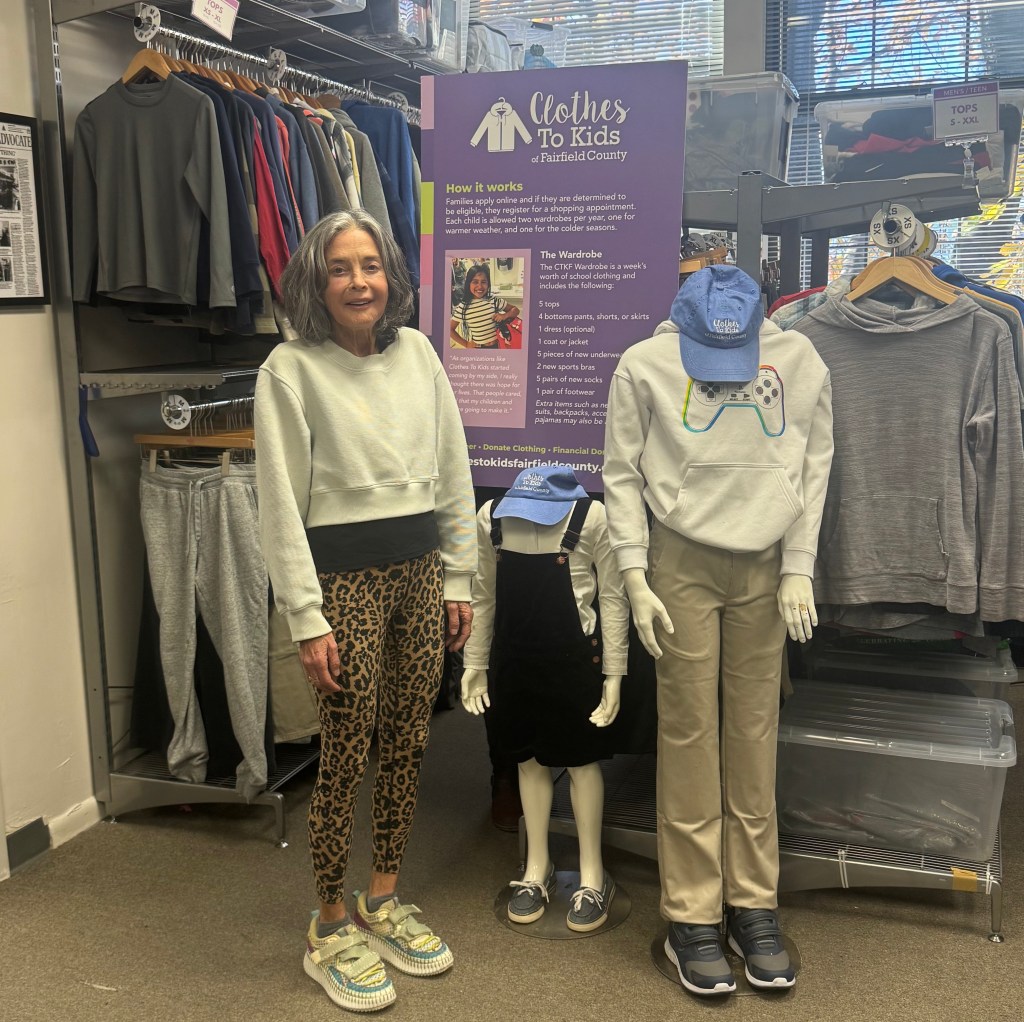
I had the pleasure of speaking to Elaine, the Executive Director (pictured). No one is more committed to spreading the word about CTKF and the desperate need for donations. Since 2016, CTKF has provided low-income and in-crisis children in grades K-12 with two school wardrobes a year, with the assistance of a personal shopper, to meet the varied seasonal needs, free of charge, each year. To meet this growing need, CTKF depends on the generosity of individuals and businesses for financial support and donations of almost new clothing, new clothing, and new shoes.

This is where my readers come in. I have listed some ways you can help Clothes To Kids of Fairfield County. (information is from their website: https://clothestokidsfairfieldcounty.org/)

Donate Clothing & Shoes

Clothes To Kids gladly accepts quality new and nearly new clothing and new shoes appropriate for children in grades K-12 to wear to school.

Accepted Items

  • NEW underwear, sports bras, socks
  • NEW bathing suits
  • Tops (shirts, blouses, sweaters, sweatshirts, hoodies)
  • Bottoms (pants, jeans, shorts, leggings, joggers)
  • Outerwear (winter and lightweight coats, jackets)
  • Footwear (sneakers, sandals, winter boots)
  • Dressy/Holiday wear (dresses, skirts, blazers, ties)
  • Accessories (backpacks, winter hats and gloves, belts, purses)

Donation Guidelines

  • Please ensure that all items are clean and in good condition.
  • No items that are dirty, stained, ripped, damaged, or have excessive wear.
  • Underwear, bras, socks, and bathing suits must be new and in their original packaging. We cannot accept used items.
  • We always appreciate items separated by gender and season, with bags labeled accordingly! (This does help hugely)

Any help you can give them is greatly appreciated, whether by donating clothing or making a monetary donation. You are helping kids in crisis in Fairfield County.

CTKF Store & General Information

The CTKF Store is located in the Lathon Wider Community Center, 137 Henry Street, Stamford CT 06902. We’re on the second floor. There is a parking lot and entrance on 34 Woodland Avenue.

STORE HOURS: Appointments are available Tuesday, Thursday, and Saturday at 10am, 11am, and 12pm.

Questions? Please get in touch:

Thank you, and until next time, Happy Thrifting!